
Stellar Shuttle
Stellar Shuttle
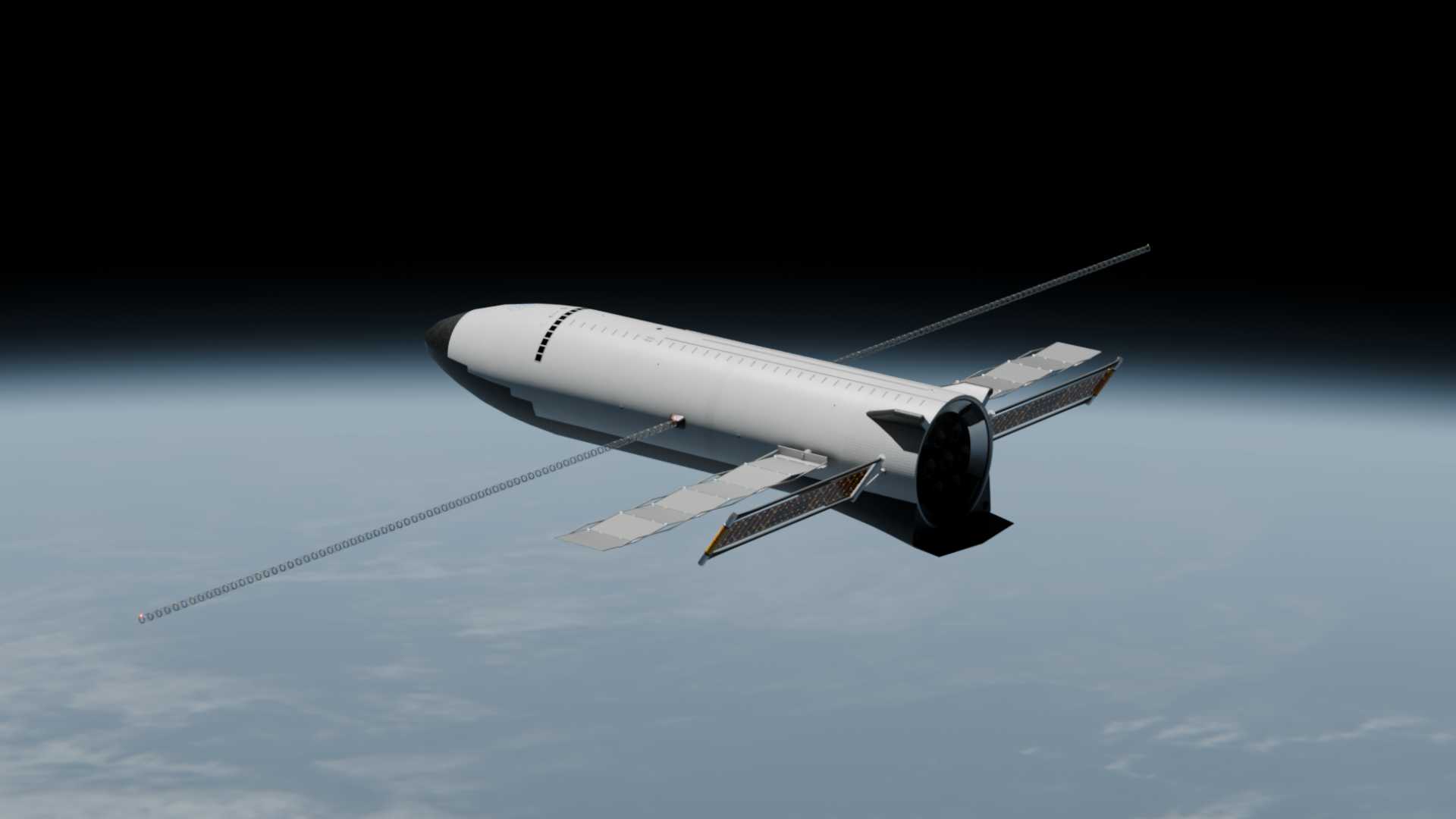
A brand new yet-to-be-named Stellar Shuttle in low Earth orbit.
| Function | Deep space transport |
|---|---|
| Manufacturer | North American Aerospace Division (main structure) Mitsubishi Lunar Corp (engines) East Asia Research (FRE, cooling and power systems) European Space Coalition (Tokamak reactor) |
| Country of origin | Global project |
| Project cost | US$1.5 trillion (2400) |
| Cost per vehicle | US$2.2 billion (2400) |
| Height | 55.4 m |
|---|---|
| Diameter | 11 m |
| Mass | 220 metric tons (max) |
| Crew size | 50 |
|---|---|
| Payload | 25 metric tons (20 light years) |
| Status | Active |
|---|---|
| Total launches | 521 |
| Success(es) | 517 |
| Failures | 4 |
| First flight | April 12, 2351 (ITS-1) |
| No. of engines | 7 |
|---|---|
| Maximum thrust | 280 kN |
| Total thrust | 1.960 MN |
| Specific impulse | 342 s |
| Propellant | LH2 / LOX |
| No. of engines | 2 |
|---|---|
| Maximum thrust | 1.6 MN |
| Total thrust | 3.3 MN |
| Power requirement | 5 GW |
The Stellar Shuttle is an active, deep space transporter operated from 2351 by the United Space Division (USD) as part of the New Exploration Program (NEP) established in 2300. Its offical program name is the Interplanetary or Interstellar Transportation System (ITS), depending on what the context was.
The spacecraft is designed to transport both passengers and cargo to a variety of destinations, including the gas giants and other star systems. It is designed to be reusable and able to withstand long-duration interstellar flights with up to 50 passengers. It is also the first spacecraft to make use of field resonance as its primary source of propulsion.
The first (ITS-1) of seven deep space test flights occured betwen 2351 to 2360, leading to operational flights (ITS-8) beginning in 2361. 21 complete Stellar Shuttle vehicles were built and flown on a total of 521 missions from 2351. Most shuttles are built at the Lunar Orbital Assembly Station (LOAS), where they are then directly launched from. Operational missions transported numerous crew members, life support and other payloads, conducted scientific experiments in deep space, and participated in the Laniakea Exploration Program.
Design
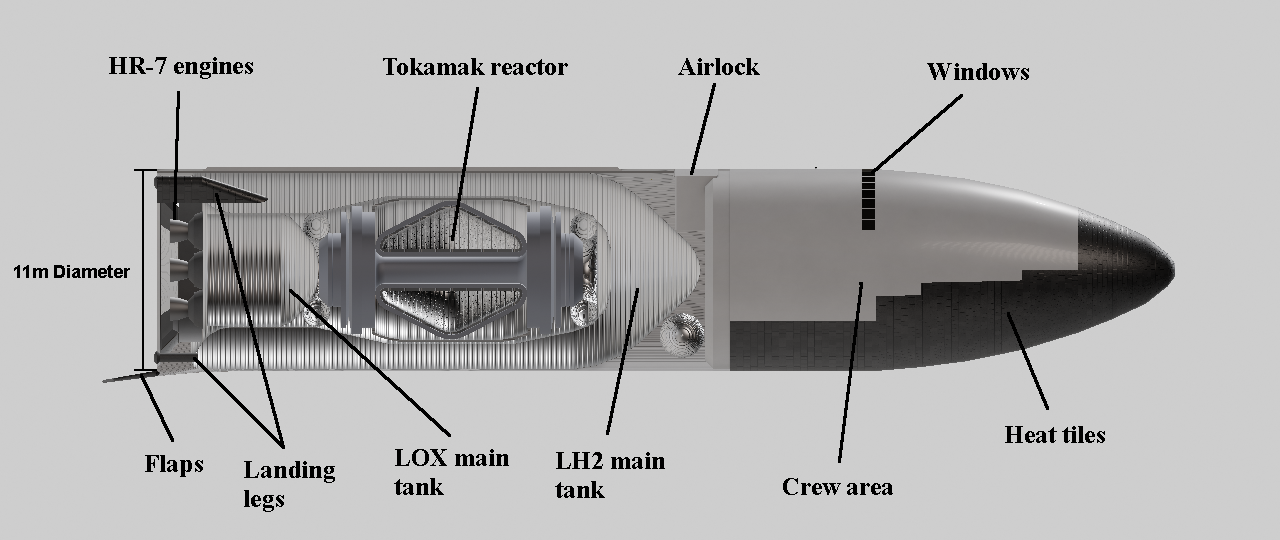 Diagram of a Stellar Shuttle's internal structure. Not shown in this diagram are the solar panels and radiators: they are placed at the bottom (or left in this orientation), the Field Resonance Engine (FRE) placed at the center of the vehicle, and the foward hydrogen tanks that surround the crew cabin.
The spacecraft is 55.4 m tall and 11 m wide, and has a dry mass of about 80 metric tons. The main structure is mostly made of "3d printed composities", likely carbon nanotubes, and is coated in an interstellar grade film. The windward side is protected by a heat shield composed of thousands of black tiles capable of withstanding temperatures of 2500 °C, and is designed to be reusuable and used thousands of times with minimal mainenance between flights. Two movable flaps are located at the rear of the Stellar Shuttle, which helps with control during atmospheric entry.
Tanks
There are two main propellant tanks that hold densified liquid oxygen and hydrogen, and are designed to store propellant for long durations with minimal boil-off. The liquid hydrogen tank features a unique toroidal shaped tank, with the liquid oxygen and Tokamak reactor in the middle. This design was chosen to limit the crew's radiation exposure from the Tokamak reactor, as hydrogen is a good absorber of radiation. The nose section of the Stellar Shuttle contain liquid hydrogen within a 10 cm wide tank which surrounds the entire crew cabin to limit the crew's exposure to cosmic and solar radiation. The tanks are manufacutured using 3d printed steels. The propellant tanks are not required to be large as most of the propulsion would be done by the Field Resonance Engine (FRE).
Power and propulsion
The Stellar Shuttle is mainly powered by a Tokamak reactor, with solar panels serving as an extra and backup power source. Heat from the Tokamak reactor is radiator away with large radiators. The Tokamak reactor (16th gen) produces a maximum output of about 25 GW, with most of the power being used to power the FRE.
The Stellar Shuttle has two main forms of propulsion: conventional engines and the FRE. The conventional liquid rocket engines are powered by liquid oxygen and hydrogen, and use a closed-loop cycle. The are only used during landing and ascent from atmospheric bodies. They are designed to be idle for long periods of time with the ability to re-ignite at quick notice.
The Field Resonance Engine (FRE) is powered by the Tokamak reactor. The engine generates thrust from "a resonance between coherent pulsed electromagnetic field waveforms and gravitational waveforms associated with spacetime metrics". This process requires large amounts of energy, however, recent breakthroughs in FRE technology has allowed for the minuturisation of FREs, and lower power requirements. This has made it possible for spacecraft to use, and even be retro-fitted with FREs, thus shorterning travel times between interstellar bodies, further reducing the size of interstellar crafts due to lesser life support required. The fastest speed achieved by a Stellar Shuttle is 0.9981 c during an uncrewed flight to Vega.